Distributed Version Control Systems
Distributed version control systems (DVCS) have revolutionized how developers collaborate and manage software projects. Unlike centralized systems, where a single server contains the full project history, in DVCS each collaborator has a complete copy of the repository, including all past changes, revision history, and branches.
Key Features of DVCS
-
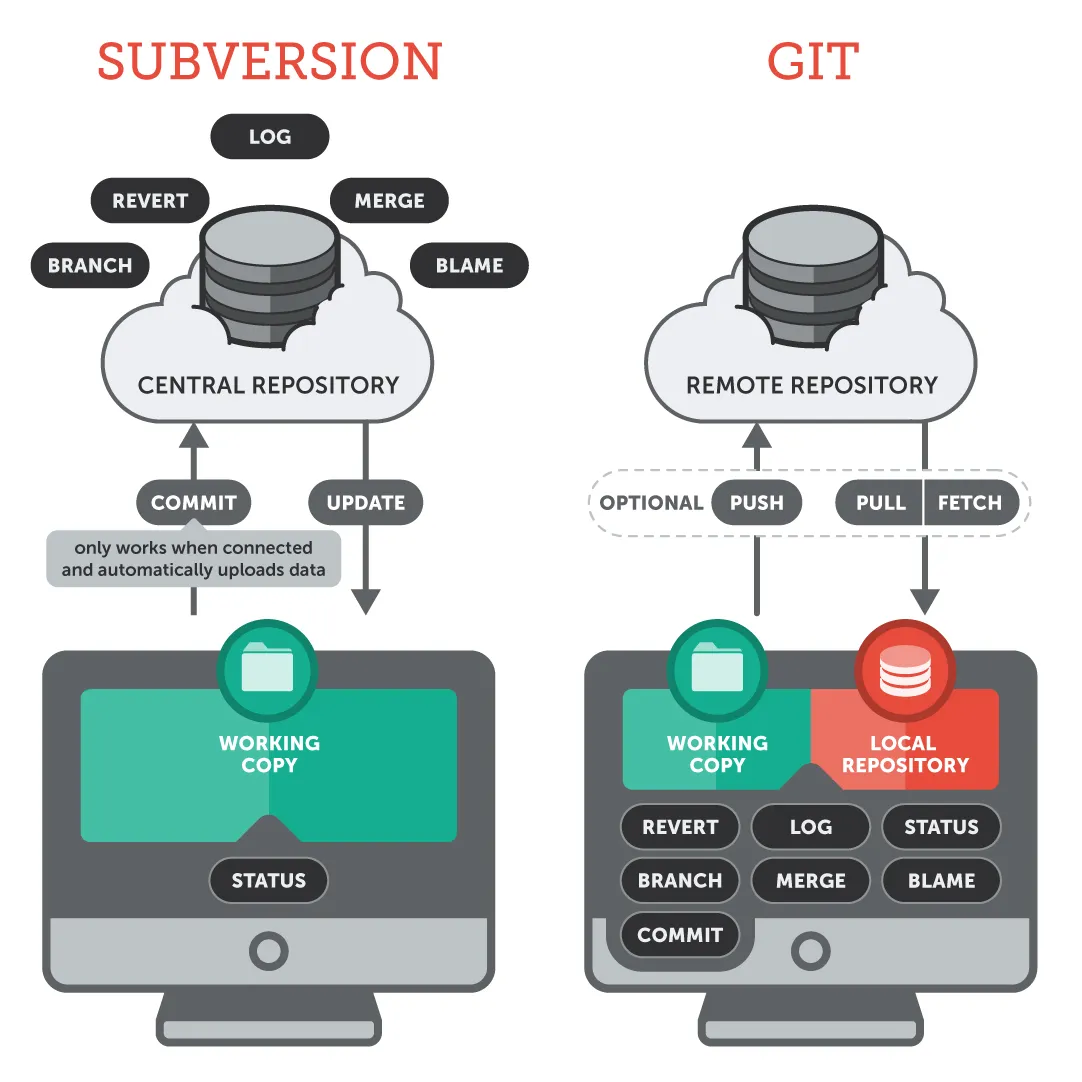
Full repository copy on each machine: In a DVCS, each user clones the repository, obtaining not only a copy of the current files but also the entire change history. This means that if the central server becomes temporarily (or even permanently) unavailable, developers can continue working locally without interruptions. Each local copy can act as a full backup of the project.
-
Offline work: One of the greatest advantages of DVCS is the ability to work without being connected to a server. Since each developer has the full history on their machine, they can perform all essential operations, such as making commits, creating branches, and merging changes, without needing internet access or a server. Once they are back online, they can synchronize their changes with the server or other collaborators.
-
Ease of collaboration between teams: DVCS allow a more flexible and collaborative workflow. Instead of relying on a single central server to perform operations like merges, developers can exchange changes directly between their local repositories. This is especially useful in globally distributed projects, where different teams can work on different parts of the project independently and then merge their changes to the central server.
-
Better branching and merging: In distributed systems, branching and merging are efficient processes essential to the workflow. Since each developer controls their own local branches, it is easy to experiment or work on new features without affecting others. Once a feature or fix is ready, the developer can merge their branch into the main code. The structure of DVCS also allows handling complex merges more smoothly than in centralized systems.
-
Greater robustness and security: Since each developer has a full copy of the project’s history, there is a lower risk of data loss. Even if the central server fails or is compromised, any developer can restore the repository to its complete state from their local copy. Additionally, distributed versions allow for more precise control over who has access to which parts of the project, enhancing security in large or confidential projects.
Two of the most commonly used version control systems of each type are SVN (Subversion) as a centralized system and Git as a distributed system.
Typical Workflow in a DVCS
-
Clone the repository: A developer starts by cloning the central or remote repository, creating a complete copy on their machine.
-
Work locally: They can work on the code, make commits locally, and create branches without needing to be connected to the server. All changes are saved in their local copy of the repository.
-
Synchronize with the remote repository: Once the developer is ready to share their work, they can “push” the changes to the server or another remote repository. Likewise, they can “pull” changes made by other collaborators from the server.
-
Merging and conflict resolution: When multiple developers are working on different parts of the code, conflicts can arise. Git and other DVCS are designed to manage these conflicts, allowing developers to merge their changes efficiently and resolve conflicts as needed.
Examples of DVCS
Distributed systems have gained enormous popularity due to their flexibility and efficiency. Some of the most well-known include:
- Git: The most popular DVCS today, used by tech giants and open-source projects worldwide.
- Mercurial: Another distributed system similar to Git, known for its simplicity and ease of use.
Conclusion
Distributed version control systems represent an evolution in software project management, offering greater flexibility, security, and efficiency than centralized systems. By allowing developers to work offline, make changes locally, and collaborate directly with other developers, DVCS have become the preferred choice for most modern software projects, with Git being the most prominent example.